
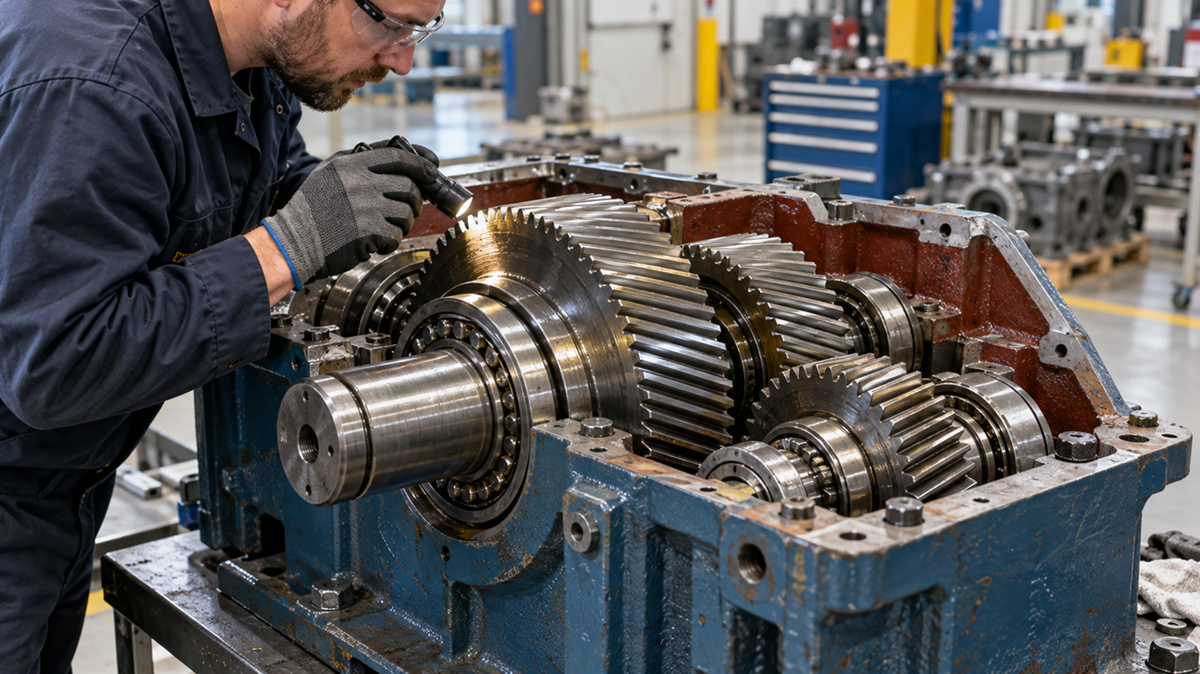
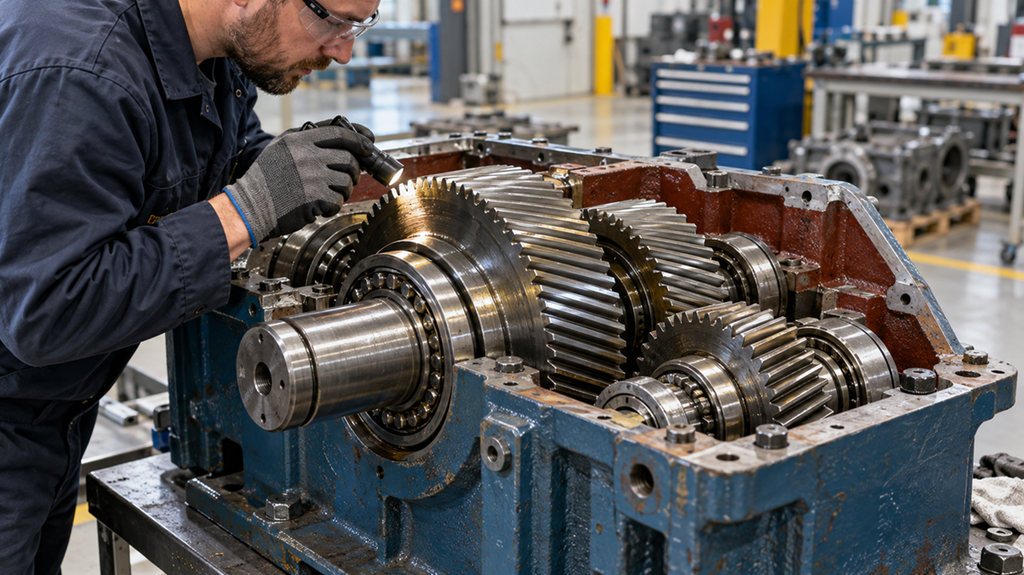
A gearbox that runs hot, leaks oil, or makes a new sound needs attention. These early signs of gearbox failure can help you catch a fault before it causes more damage.
Yet one symptom can have several causes. Low oil levels, worn bearings, or cooling faults can cause excess heat. Noise may come from damaged gears or other drive components. Manufacturer guides list several possible causes.
Industrial gearbox troubleshooting starts with three questions:
- What changed? Note any new noise, heat, leaks, or loss of output.
- When does it happen? Check whether it starts with the machine, under load, or after it warms up.
- What evidence can you gather? Review oil condition, readings, and service records.
This gearbox symptom-to-cause guide covers common industrial gearbox problems and the checks that help narrow them down. It focuses on industrial gear reducers used to drive plant equipment.
Keep the original equipment manufacturer (OEM) operating manual close by. Use its oil specs, test methods, and limits when you assess the fault.
1. Industrial Gearbox Troubleshooting Chart: Start With Your Symptom
Start with what has changed. Does the gearbox sound louder, run hotter, or leak oil? These industrial gearbox failure symptoms point you to useful checks, but they don’t prove which part has failed.
Use this gearbox troubleshooting chart to choose where to begin. Manufacturer guides also list several possible causes for each symptom.
| Symptom | Possible causes | First checks |
| Unusual noise | Worn gears, damaged bearings, or poor lubrication | Note when the sound starts. Check oil level and service records. |
| Excessive vibration | Shaft misalignment, loose mounts, or internal wear | Review vibration trends, mounting condition, and shaft alignment. |
| Overheating | Too much or too little oil, excess load, or poor cooling | Check the oil specification, load, cooling fan, and oil cooler. |
| Oil leaks | Worn seals, overfilling, or a blocked breather | Find the leak source. Check the fill level and breather. |
| Foamy or milky oil | Trapped air, water, or mixed lubricants | Review recent oil changes and take an oil sample. |
| Low or missing output | A failed connection, internal damage, or a blocked drive system | Check the full drive system, including the motor and couplings. |
Milky oil needs a closer check. Water and air can both affect how oil looks. An oil test can help confirm the cause.
For sound industrial gearbox fault diagnosis, compare the symptom with the unit’s normal state. Record the speed, load, and temperature when it occurs. This supports industrial gear reducer troubleshooting and gives the repair team useful facts.
Before hands-on checks, follow the site’s shutdown and lockout/tagout steps to prevent hazardous energy from causing injury.
2. What Should You Check Before Troubleshooting a Gearbox?
Before you inspect parts, gather the facts. A clear industrial gearbox inspection checklist helps you spot changes and avoid guesswork.
Record When the Problem Happens
Write down when you first noticed the fault. Does it happen:
- At startup or after the gearbox warms up?
- Under load or with little load?
- At one speed or at all speeds?
- During steady use or shutdown?
- After an oil change, repair, or new installation?
Note whether the change was sudden or slow. These details support gearbox root-cause failure analysis, which aims to determine why the fault began.
Collect the Gearbox’s Operating Information
Take a clear photo of the nameplate. Gather these details before you call a repair team:
| Information | What to record |
| Gearbox details | Manufacturer, model, serial number, and gear ratio |
| Operating conditions | Input speed, load, mounting position, and hours of use |
| Lubricant | Oil type, viscosity grade, and last change date |
| Service history | Past repairs, leaks, and replaced parts |
| Previous readings | Normal temperature and vibration levels |
Manufacturer guidance recommends sharing nameplate data, the fault type, and when it occurs when seeking help.
Know When to Stop and Isolate the Equipment
Knowing when to shut down an industrial gearbox is part of the first check. Follow the OEM manual and site procedures if you find severe noise, sudden vibration, fast oil loss, or a protective trip. Do not keep restarting the unit to test whether the fault clears.
3. Why Is Your Industrial Gearbox Making Unusual Noise?
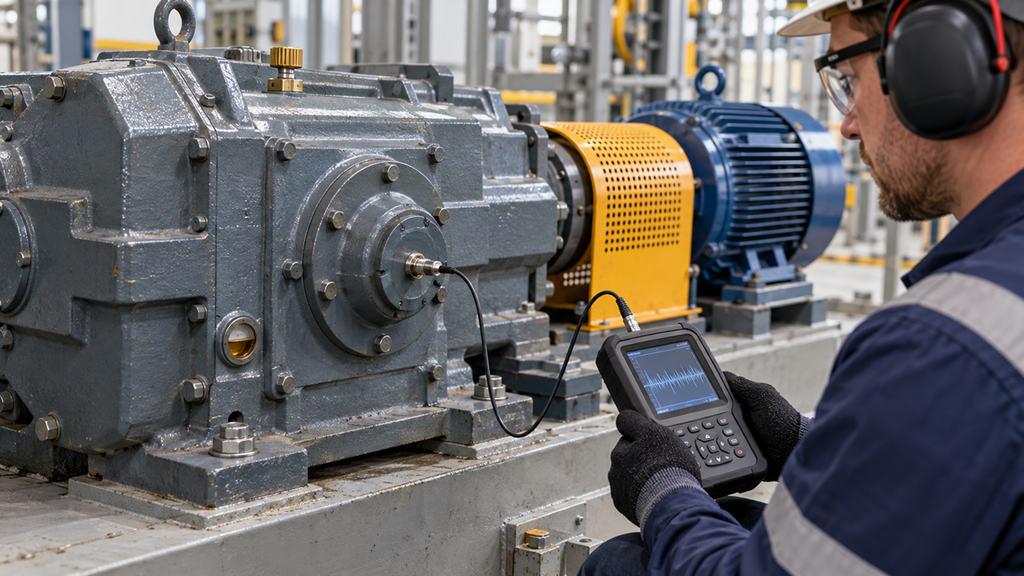
A new sound can warn you of a fault. Yet industrial gearbox noise can have overlapping causes. Worn gears, damaged bearings, and poor lubrication may produce similar sounds. Manufacturer guides treat noise as a reason to check further, not proof of a failed part.
Whining or Humming
For gearbox whining noise diagnosis, note whether the pitch changes with speed or load. Possible causes include poor lubrication, worn tooth surfaces, or uneven gear contact.
If you notice gearbox noise after an oil change, check the oil type and fill level against the manual. Record whether the sound began right after the service.
The pinion, the smaller gear in a mating pair, can also cause the noise. A specialist can assess its gear mesh signals through vibration analysis.
Grinding or Rumbling
A gearbox grinding noise under load may point to damaged parts or poor lubrication. A gearbox rumbling noise may indicate a bearing issue, but sound alone cannot confirm the fault.
A rolling-element bearing supports a shaft as it turns. Damage to its working surfaces can affect noise and vibration. Changes in sound, heat, and vibration help guide bearing checks.
Knocking, Clicking, or Rattling
Possible causes of gearbox knocking include tooth damage, loose parts, or excess clearance. Gearbox rattling at startup may also involve loose connections or changing load.
Record whether the sound repeats at a steady rate. Note any gearbox noise during deceleration, since changing load can help a specialist narrow the search.
How to Narrow Down the Noise Source
Useful gearbox bearing noise diagnosis combines several clues:
- When it happens: Record speed, load, and temperature.
- Where it is strongest: Have trained staff assess safe measurement points.
- What else changed: Check vibration trends and oil test results.
- Nearby parts: Include the motor, shaft coupling, and driven machine.
Do not label a sound as gear tooth damage noise without supporting evidence. Vibration analysis can help separate gear mesh activity from bearing faults.
4. What Causes Excessive Gearbox Vibration?
A change in vibration is a reason to inspect the drive. Common causes of industrial gearbox vibration include poor alignment, loose mounts, worn bearings, and gear damage. The fault may also come from the motor or driven machine.
Misalignment and Coupling Problems
Shaft misalignment occurs when connected shafts do not line up as required. They may meet at an angle, sit off-center, or have both faults.
Possible gearbox misalignment symptoms include vibration, heat, and repeated coupling wear. Yet these signs need further checks.
For gearbox coupling vibration, inspect the coupling’s condition and installation during a safe shutdown. After a motor change, gearbox repair, or base movement, review alignment.
Loose Mounting, Soft Foot, and Structural Problems
Loose gearbox mounting bolts can let the unit move. Check the base, supports, and bolts. Use the specified tightening method and torque.
Soft foot means the mounting feet do not rest evenly on the base. Diagnosing gearbox issues involves checking for soft foot and gaps or movement that may distort the machine when you tighten the bolts.
A sharp rise in vibration within a narrow speed range may indicate gearbox resonance. Resonance can amplify vibration when a forcing frequency is close to a structure’s natural frequency.
Bearing and Gear Faults
Gearbox vibration analysis helps specialists identify vibration sources.
One useful reference is gear mesh frequency (GMF). It equals a gear’s tooth count multiplied by its shaft speed in revolutions per second.
During gear mesh frequency analysis, an analyst may review:
- Harmonics: Multiples of a reference frequency.
- Sidebands: Peaks spaced around a main frequency.
- Bearing signals and changes over time.
GMF appears in healthy gearboxes too. A peak alone does not prove damage. Gearbox vibration spectrum interpretation needs speed, load, and other evidence.
Which Vibration Checks Are Most Useful?
For useful gearbox vibration trend monitoring, compare readings taken at the same points under similar conditions. An accelerometer measures vibration acceleration. A Fast Fourier Transform (FFT) helps display its frequency content.
If you find excessive gearbox vibration under load, record the load and speed. Compare the results with the machine’s baseline and OEM guidance. Bearing checks may also use acceleration enveloping to reveal impact signals.
5. Why Is Your Industrial Gearbox Overheating?
Heat is a symptom, not a diagnosis. Common causes of industrial gearbox overheating include poor lubrication, excess load, and cooling faults. Worn parts or poor alignment may also add heat.
If the gearbox runs hotter than normal, compare the reading with past records and the OEM limits.
Incorrect Oil Level or Lubricant
Both low oil and too much oil can cause trouble:
- Too little oil may leave parts without enough lubrication.
- Too much oil can cause churning, which adds heat.
- Incorrect gearbox oil viscosity can affect oil flow and film strength.
- Incompatible gearbox lubricants may not work well when mixed.
Check the oil level using the method and conditions set out in the manual. Manufacturer guidance lists both high and low oil levels as possible causes of excess temperature.
Overload or Increased Mechanical Friction
For gearbox overheating under load, check whether the work has changed. A faster production rate, heavier load, or jammed driven machine may increase demand.
Also review gearbox bearing temperature rises. Check for wear, poor lubrication, and alignment faults. Heat alone cannot confirm bearing damage.
Cooling and Ventilation Problems
Dirt on the gearbox housing can hinder heat loss. Blocked airflow, a gearbox cooling fan failure, or a gearbox oil cooler blockage can also reduce cooling.
During a safe shutdown, inspect the cooling system fitted to your unit. Check its service instructions before cleaning or testing parts.
How Hot Is Too Hot?
No single safe limit applies to every gearbox. Use the OEM’s limits for the oil, bearings, and housing.
For useful gearbox oil temperature monitoring, record the load, speed, and nearby air temperature. Keep surface readings separate from oil sump readings.
Gearbox thermal imaging inspection, also called infrared thermography, shows surface heat patterns. It can help identify areas for further checks, but it doesn’t directly measure internal oil temperature.
What If Overheating Starts After an Oil Change?
For gearbox overheating after an oil change, verify:
- The approved oil type and viscosity grade.
- The correct fill level and oil level sensor position.
- Whether old and new oils are compatible.
- Whether the filters, pumps, and coolers are working as required.
This approach supports gearbox temperature rise troubleshooting without replacing parts based on heat alone. OEM lubrication guidance covers oil selection, sampling, fill checks, filters, and coolers.
6. Why Is the Gearbox Leaking Oil?
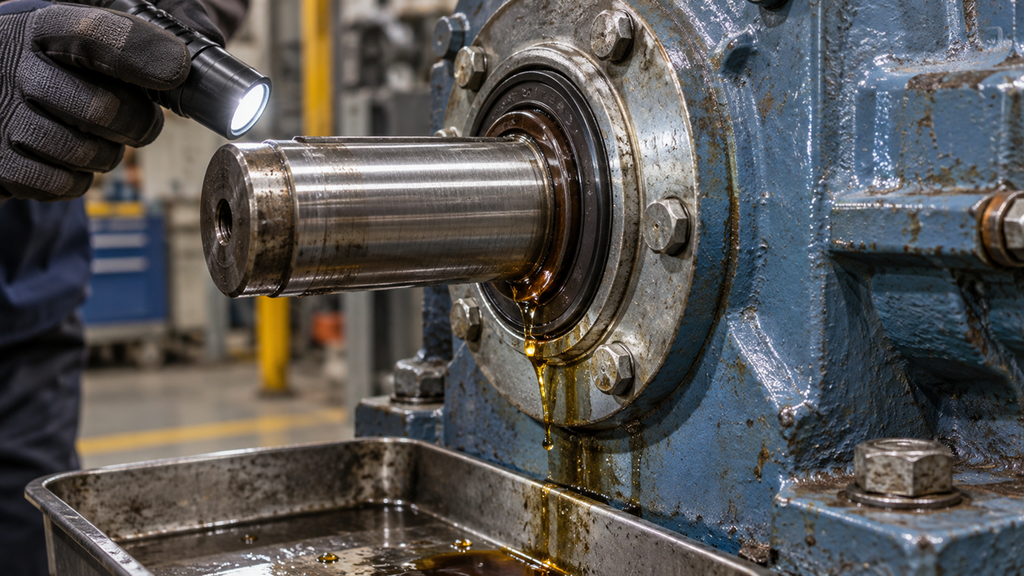
An oil leak can lower the oil level and let dirt or water enter. Common causes of industrial gearbox oil leaks include worn seals, loose fittings, overfilling, and pressure problems.
First, find the source. Oil can flow down the gearbox housing, so the wettest spot may be below the actual leak.
Leaks at Input or Output Shaft Seals
A radial shaft seal helps keep oil inside as the shaft turns. If you find a gearbox input or output shaft seal leaking, inspect more than just the seal.
Possible causes include:
- A worn or damaged seal.
- A groove on the shaft’s sealing surface.
- Excess shaft movement.
- Poor seal installation.
Check shaft and bearing condition before fitting a new seal. Manufacturer troubleshooting guidance identifies worn or damaged shaft seals as a possible source of leaks.
Oil Escaping From the Breather
The breather helps the gearbox balance its internal air pressure. Symptoms of a blocked gearbox breather may include pressure buildup and oil escaping at seals or joints.
A leaking gearbox breather can also point to overfilling or foaming. These are possible symptoms of gearbox overfilling, but they need further checks. Manufacturer guidance links oil escape with excess oil, mounting position, and foaming.
Leaks at Housing Joints, Plugs, or Inspection Covers
For a gearbox housing joint oil leak, check the joint, cover, gasket, and nearby fittings during a safe shutdown.
Clean the area using an approved method, then trace the source. Do not tighten bolts at random. Follow the OEM’s torque values and tightening order.
If you notice the gearbox oil level dropping, record how fast it falls. Read the oil sight glass or dipstick under the conditions set out in the manual.
Why Replacing the Seal May Not Solve the Problem
Recurring gearbox seal failure calls for a wider check. A new seal may leak again if shaft wear, bearing movement, or built-up internal gearbox pressure remains.
Confirm the cause, repair it, and check the oil level before returning to service. Track the area afterward to see whether the leak returns.
7. What Does the Gearbox Oil Tell You?
Oil can reveal clues about wear, heat, and dirt inside the unit. Yet color alone cannot confirm a fault. Interpret the results by combining gearbox oil analysis with service records and changes over time.
Milky or Hazy Oil
Milky gearbox oil may include water or trapped air. Both can make the oil look cloudy.
If you suspect water contamination in gearbox oil, check possible entry points. These include seals, breathers, washdown areas, and water-cooled heat exchangers. Take a sample to confirm the cause before choosing a fix.
Foamy Oil
A few bubbles that quickly clear differ from foam that persists. Persistent foaming in industrial gearbox oil may involve trapped air, contamination, or mixed oils. It can reduce gear protection and add heat.
Check the oil type, fill level, and recent service work. Do not add an anti-foam product without approval from the OEM and lubricant supplier.
Burnt-Smelling or Darkened Oil
A burnt smell from gearbox oil may indicate overheating or oil breakdown. Dark oil alone does not prove that the lubricant has failed.
Gearbox oil oxidation is a chemical change that can affect the oil’s useful life. Compare a used-oil sample with fresh oil and past results. Check viscosity and other lab findings before deciding on action.
Metal Particles or Debris
Metal particles in gearbox oil need closer review. Fine wear particles and large chips do not carry the same meaning.
Useful gearbox wear debris analysis considers particle size, shape, type, and quantity. A sudden change from previous samples may be more useful than a single result. Keep visible fragments for the repair team to inspect.
Which Oil Tests Help?
| Test or method | What it helps assess |
| Viscosity test | Whether oil thickness has changed |
| Karl Fischer titration | The amount of water in the oil |
| Wear metal analysis | Elements that may come from worn parts or contamination |
| Analytical ferrography | The size and shape of ferrous wear particles |
| Total acid number (TAN) | Changes in oil acidity that need review against a baseline |
Follow the OEM’s sampling method. Use a clean container, record the sampling point, and note any recent oil top-ups. Manufacturer lubrication guidance covers both oil sampling and reviewing test results.
8. Why Is the Gearbox Losing Torque, Stalling, or Producing No Output?
When a machine slows or stops, check the whole drive system. Gearbox torque loss may involve the motor, shaft connections, internal parts, or driven equipment.
The Input Shaft Turns, but the Output Does Not
The input shaft brings power into the gearbox. The output shaft sends it to the machine.
If the gearbox input shaft turns but the output does not, a connection may have failed. Possible faults include a broken coupling, damaged splines, or a failed gearbox shaft key. A key is a small part that helps lock a hub to a shaft.
Manufacturer guidance lists a failed internal shaft-to-hub connection as one possible cause of missing output. This calls for repair assessment.
The Gearbox Stalls Under Load
If a gearbox stalls under load, check for a jam, heavier process load, or a motor problem. Internal damage may also add resistance.
Possible gearbox overload symptoms include heat, higher motor current, and protective trips. Check these signs before naming the cause.
Record any sudden stops or impacts. Gearbox shock load damage may follow a sharp change in force, such as a conveyor jam.
Output Speed or Motion Is Irregular
For gearbox output speed fluctuations, compare motor speed with output speed and process load. Review control settings and drive connections.
If the gearbox starts then stops under load, record any fault code and when the stop occurs. A trained technician can use this evidence to separate motor, control, and mechanical faults. Manufacturer service guidance treats these as distinct checks.
A backstop prevents reverse rotation in some drives. Symptoms of gearbox backstop failure, such as unexpected reverse movement, need prompt specialist review.
Motor Current Has Increased
When checking excessive motor current, compare readings at the same speed and load. High current can reflect greater demand, mechanical drag, or an electrical fault. It does not prove gearbox damage.
Possible causes of reduced gearbox efficiency include poor lubrication, excess friction, and worn parts. Confirm the cause with operating data and inspection.
Follow shutdown and lockout/tagout procedures before hands-on checks. Do not remove guards or touch moving shafts to test output.
9. Which Tests Can Confirm the Likely Cause?
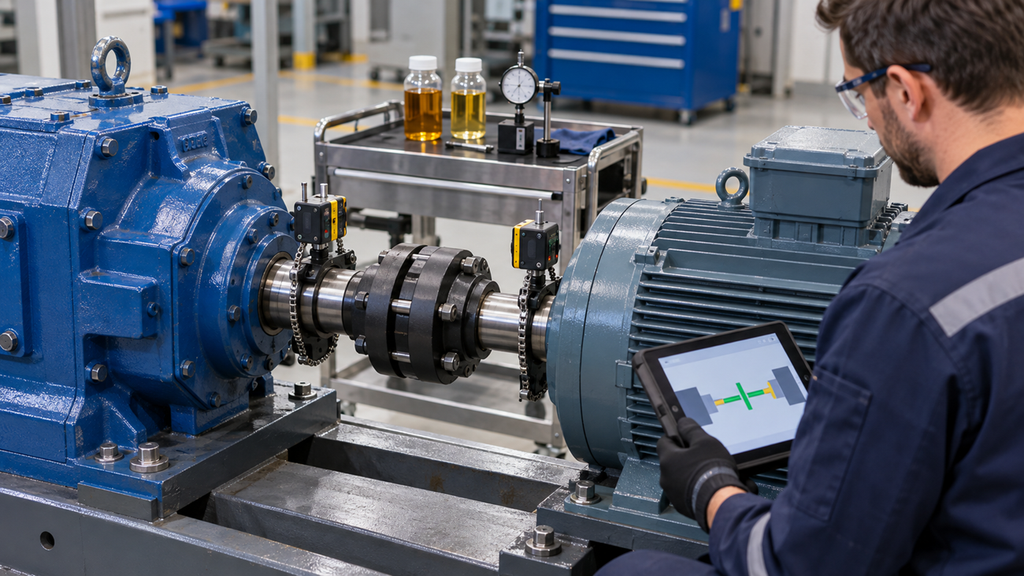
A symptom tells you where to look. Tests help you find the fault. Choose checks based on the problem, then compare the results with the OEM’s limits.
No single test shows the full picture. Gearbox condition monitoring combines readings, oil tests, and inspections to track changes over time.
Vibration Analysis and Oil Tests
Vibration analysis helps assess gear and bearing activity. A tachometer measures shaft speed, allowing an analyst to link vibration peaks to rotating parts.
Oil tests add evidence about wear and lubrication. For example, debris in an oil sample may support a finding from vibration data. SKF explains how vibration methods help assess gear and bearing condition.
Thermal Imaging and Internal Inspection
A thermal scan can show hot areas that need further checks. Compare scans taken under similar loads and conditions.
A gearbox borescope inspection uses a small camera to view parts through access openings. A borescope may reveal visible damage, but it cannot show every surface or confirm every crack.
During an internal inspection, a specialist may assess gearbox gear tooth wear patterns, including:
| Finding | What it means |
| Macropitting | Visible pits on the working tooth surface |
| Micropitting | Fine surface damage that may look gray or frosted |
| Scuffing | Surface damage linked to sliding contact and loss of oil film |
| Abrasive wear | Material worn away by abrasive action |
| Tooth root cracking | Cracks near the base of a tooth |
Diagnosing gear tooth pitting and scuffing requires more than a photo. You must also review load, oil condition, and contact.
The International Organization for Standardization (ISO) publishes ISO 10825-1:2022, which defines terms for gear tooth wear and damage. It provides a common language for describing damage.
Shaft Alignment and Movement Checks
Gearbox laser shaft alignment uses a laser shaft alignment system to measure shaft alignment.
A dial indicator can help measure gearbox shaft runout and check for excessive gearbox shaft endplay. Runout is variation as a shaft turns. Endplay is movement along its length.
These checks help assess possible symptoms and causes of a bent gearbox shaft and gearbox shaft misalignment. Compare each result with the correct tolerance before deciding on a repair.
Backlash and Gear Contact Checks
Backlash is clearance between mating teeth. Excessive gearbox backlash can cause symptoms such as knocking during load changes; measure it to confirm.
A gearbox tooth contact pattern inspection shows where mating teeth touch. An uneven gear tooth contact pattern may call for checks of alignment, bearings, and assembly.
Inspect both the gear tooth flank, which carries contact, and the gear tooth root, where bending cracks may start.
Bearing Clearance and Preload Checks
Gearbox bearing clearance and preload issues require model-specific checks. Preload is a set load applied within some bearing arrangements.
Excessive preload or unsuitable clearance can cause damage. Bearing spalling means small pieces have flaked from a working surface. SKF and NSK guidance links bearing damage to several possible causes, so you must assess the damaged part in context.
Record the findings before replacing parts. This helps prevent a repeat failure of an industrial gearbox bearing.
10. Should You Repair, Rebuild, or Replace the Gearbox?
The best choice depends on the damage, parts supply, and cost of lost production. Decide between industrial gearbox repair and replacement after an inspection.
When a Maintenance Correction May Be Enough
Some faults may need a service correction rather than new internal parts. Examples include:
- An incorrect oil level.
- A blocked breather or dirty cooling system.
- Loose mounts or poor shaft alignment.
- An external leak with a confirmed cause.
First, check for damage caused by the fault. Adjusting the oil level may not be enough if gears or bearings ran without proper lubrication.
When Internal Inspection or Rebuilding Is Needed
Persistent noise, abnormal debris, or excessive shaft movement may require an internal inspection.
A rebuild may involve new bearings, seals, gears, or shafts. Measure and check each part against its limits.
Findings that need close review include:
- Gear tooth spalling: Pieces have flaked from the tooth surface.
- Gear tooth root cracking: A crack has formed near the tooth base.
- Tooth root bending fatigue: Repeated bending loads have caused damage.
- Abrasive wear in industrial gears: Abrasive action has worn away material.
Symptoms of broken gear teeth include repeated knocking, sudden vibration, or loss of output. These signs need inspection to confirm the damage. ISO’s gear damage standard helps specialists describe wear and failure types consistently.
A locked shaft also needs expert review. Gearbox bearing seizure may result from lubrication, clearance, load, or heat damage. Do not force the shaft to turn.
When Replacement May Be More Practical
Compare the full cost and expected result of each option.
| Factor | What to compare |
| Damage | Which parts can be restored or replaced? |
| Parts supply | Are the required parts available? |
| Downtime | How long will each option keep production stopped? |
| Operating needs | Does the unit suit the current load and duty? |
| Total cost | Include removal, installation, alignment, and startup checks. |
Confirm the design before choosing a replacement. Helical, bevel, worm, and planetary gearboxes have different layouts. A matching ratio alone doesn’t prove a replacement will fit or suit the job.
What Information Should You Send a Repair Specialist?
Share:
- Clear nameplate and installation photos.
- A short symptom timeline.
- Speed, load, and mounting details.
- Oil test and vibration reports.
- Service records and photos of debris.
Manufacturer service guidance recommends providing nameplate data, fault details, and the conditions under which it occurred. This helps the repair team plan the next checks.
11. How Can You Prevent the Same Gearbox Problem From Returning?
A repair should fix both the damage and its cause. A new bearing or seal may fail again if poor lubrication, excess load, or misalignment remains.
Confirm the Root Cause Before Startup
Review what caused the fault and how you corrected it. If gearbox lubrication failure symptoms led to the repair, check the full oil system.
Where fitted, inspect the lubrication pump, oil filter, oil lines, and cooler. Confirm that the right oil reaches the parts that need it. OEM lubrication guidance covers oil checks, filters, coolers, and related service tasks.
Also review any gearbox coupling wear symptoms. Replacing a worn coupling without correcting alignment or load problems may leave the cause in place.
Create a Gearbox Preventive Maintenance Checklist
Use a gearbox preventive maintenance checklist based on the OEM manual and site conditions.
| Check | What to record |
| Oil level | Reading taken under the specified conditions |
| Oil condition | Foam, haze, debris, and lab results |
| Temperature | Reading, load, speed, and nearby air temperature |
| Vibration | Readings from the same measurement points |
| Leaks | Location and any change in oil loss |
| Mounting and alignment | Inspection findings and corrections |
| Cooling system | Fan, airflow, and cooler condition |
Train staff to report symptoms of low gearbox oil, such as a low sight-glass reading or a sudden drop in level. Heat or noise may also occur, but neither proves that low oil is the cause.
Set a Baseline After the Repair
Once the unit runs within its approved limits, record its normal temperature, vibration, noise, speed, and load.
Use these readings as a baseline. Comparing future results under similar conditions helps reveal changes. SKF describes trend monitoring as a way to detect shifts in machine condition.
Match Service Intervals to the Job
Follow OEM guidance, then account for dust, water, heat, load, and hours of use. Set inspection and oil-sampling intervals to suit those conditions.
Keep a clear log of faults, repairs, and test results. If the same problem returns, the record helps the team find what still needs attention.
Frequently Asked Questions
What Are the First Signs of Industrial Gearbox Failure?
Common signs include new noise, rising heat, oil leaks, and increased vibration. The machine may also slow down or lose output. Compare each change with normal readings, then check the likely causes.
Can Low Oil Cause Both Noise and Overheating?
Yes. Too little oil reduces lubrication and can cause wear, noise, and heat. Check the level using the OEM’s method. If oil is low, find out why before returning the unit to service.
Can Overfilling a Gearbox Cause Problems?
Yes. Excess oil can cause churning, heat, foam, and leaks. Use the fill level specified for the gearbox’s mounting position. Manufacturer troubleshooting guidance lists both high and low oil levels as possible causes of excess temperature.
How Do You Tell Gear Noise From Bearing Noise?
Sound alone is not enough. A specialist can compare vibration signals with shaft speed and gear mesh frequency. Oil tests and internal inspections may provide additional evidence. SKF guidance shows how vibration analysis can help separate gear signals from bearing faults.
Why Does a Gearbox Overheat After an Oil Change?
Check the oil type, viscosity, fill level, and service procedure. Also review whether the old and new oils are compatible. Use the OEM’s lubrication instructions to guide these checks.
Can You Keep Running a Gearbox That Leaks Oil?
There is no safe answer for every leak. Check the leak rate, oil level, location, and OEM instructions. Follow site shutdown procedures if oil loss threatens lubrication or creates a hazard. Repeated top-ups do not fix the cause.
Can a Gearbox Fault Cause High Motor Current?
Yes. Internal drag or damage can increase the motor’s load. But high current may also come from the driven machine, motor, or electrical supply. Check the whole drive system before blaming the gearbox.
When Should You Call a Gearbox Repair Specialist?
Seek help for severe or repeated noise, fast temperature rise, large metal fragments, excessive shaft movement, or lost output. Also seek help when basic checks don’t reveal the cause.
Share the nameplate data, symptoms, service history, and test results. These details help the specialist plan an inspection.
Conclusion: Use the Symptom to Guide the Next Check
Industrial gearbox troubleshooting starts with a clear record of what changed. Note the noise, heat, vibration, leak, or loss of output. Then check when it happens and compare it with the unit’s normal readings.
Use each symptom to guide your next check. Review the oil, load, alignment, and cooling system. When needed, use vibration analysis, oil analysis, and internal inspection to confirm the fault.
Follow the OEM operating manual for limits and service steps. Fix the cause, replace the damaged part, and monitor the gearbox after it returns to service. If the cause is still unclear, request an industrial gearbox inspection.